
After 10+ years in professional writing, I’ve noticed a few traits that separate hobby writers from professionals. If you want to become a good writer, take a page from their book and start doing these eight things…
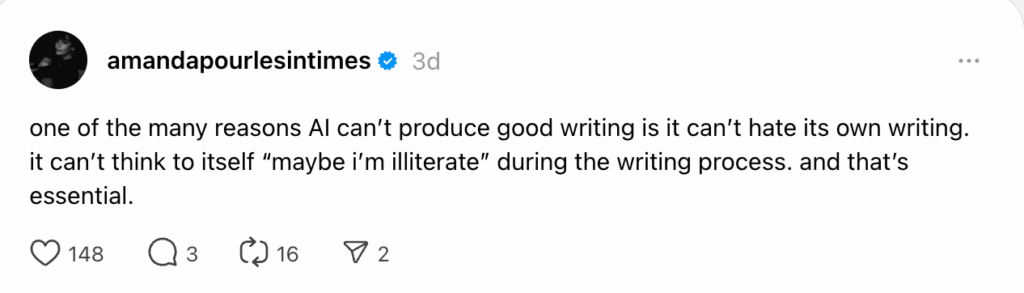
I recently ran across this Thread (see below) about the reason AI can’t produce good writing. For those of us who spend hours typing at our desks, only to return a few hours later to get “the ick” from every paragraph, it’s objectively hilarious. And all too relatable.
But it got me thinking … what actually makes a good writer? It’s one thing to pick up a book and decide, “This is beautifully written.” It’s another to understand why it’s beautifully written and what process the writer used to get those results.
POV: You’re a Good Writer (Here’s What You Did to Get There)
The good news is, you don’t have to be a natural-born writer to be a good one. At its core, writing is a mental game. After years of working in the field, here are a few things I’ve noticed that separate hobby writers from professional writers.
You’re mentally resilient in the face of criticism
Writing is part talent, part practice, and part mental game. You need enough confidence in your craft that you won’t just run with anyone’s advice. But not so much confidence that your ego can’t handle criticism. It’s a balancing act.
Like the Thread above says, you can wonder, “Maybe I’m illiterate.” But then you bounce back and keep writing. You’re confident but teachable. You’re mentally resilient, but you know how to make people feel through words. You know how to return to your desk even in the face of criticism or during busy life seasons.
You’re a free thinker
The Thread above brings up an interesting point about writing. It’s your job to decide when a sentence is objectively good or bad. This isn’t like math, where there’s always a correct answer. This is art. You have to decide when a sentence makes sense and when it doesn’t. And you have to be good at deciding.
A lot of people think they’re good at writing because they’re good at the formula. They’re good at prepositions, don’t use sentence fragments, and use the Oxford comma. But that’s good grammar, not good writing. A talented writer learns the rules so they can break them. They innately understand what good writing looks and feels like, beyond the grammar and structure. They’re free thinkers who know how to see value in something without the formula.
You don’t accept feedback from everyone
Critique groups, beta readers, and agent feedback sessions are often the downfall of good writers, especially if they’re working with a first draft. You shouldn’t get feedback on your novel until you’ve exhausted your own genius. I’m talking multiple drafts, writing courses, books about writing, blog posts, and more. Put everything you have into that novel, and make sure it’s something you’re proud of before showing it to anyone else.
I say this because I’ve seen critique groups turn into a “too many cooks in the kitchen” situation. When writers lack confidence in their novels, they turn to other creatives to improve their work. This snowballs into an endless revision process, where you lose the heart of the novel. It becomes a group project, not a personal project. And writing is deeply personal.
So, instead of immediately looking for validation from fellow writers, work on your novel alone until you hit a wall. Talk through the plot points with friends, but don’t let them read it. When you’re confident in your own genius, then you’re ready to pick 2–3 writing pros to read your work. When it’s time for feedback, your job is to filter every critique through the lens of “what’s best for my novel?” Remember, never take advice from someone who hasn’t been where you want to go.
You practice to become a master of your craft
Speaking of confidence, let’s talk about what builds confident writers. It’s not a massive ego or your writing buddy who showers your Google doc with positive emojis. It’s the hours you spend practicing. You have to practice so often that it’s literally impossible for you to be a bad writer. Bingo, now we’re talking mastery.
Since we all learn writing basics in school, it’s easy to overestimate our abilities. But writing is a professional skill. We don’t automatically get to be good writers if we’re creative and know how to punctuate a sentence. We have to work for it.
Think of it this way: math is taught in school, too, but we’re not all rocket scientists. There’s a significant education gap between high school math and an aerospace engineer. So, apply that same education gap to your writing. What would it take to make you the top in your field? Start with the 10,000-hour mastery rule and work from there.
You’re good at both character-driven and plot-driven elements
When you start writing books, professionals will ask you, “Is this a character-driven or plot-driven novel?” Of course, you’ll have an answer. Writers need their area of expertise, and if you read plot-driven novels, you’ll naturally become someone who writes them.
Whatever camp you land in also tells you which technique needs intentional work. The best stories aren’t plot-driven or character-driven; they’re both. I’ve recently been captured by two mysteries that do this well. The Residence (a Netflix series) and the Knives Out movies. Both of these stories fall into the plot-driven category, but their brilliant, colorful characterization turns them into classics.
You don’t copy someone else’s genius
When I worked as a literary agent, I can’t tell you how many pitches I heard that were recycled versions of Lord of the Rings. Sure, a few details were changed, but the stories were set in the same universe with the same quest for power. This is sad for a few reasons. For one, there will never be another Lord of the Rings. That’s why it’s so good. For another, when you choose to copy someone else’s genius, you lose your own.
The people who write classics are the people who ask the question, “What’s never been done in literature before?” Take a page from J.R.R. Tolkien’s book, and think outside the box. The world wants your genius, not your interpretation of someone else’s.
Your theme captures what it means to be human
These days, we’re confusing themes with opinions. It’s easy to do in the social media era. Opinion is currency. It’s what determines our friendships, our values, and our politics. But in placing so much emphasis on what separates us, we’ve lost what unites us. And that’s what a theme is.
At its core, a theme is something that makes people feel seen. From the poorest child to the richest one, from war-ravaged countries to peaceful ones, and from the youngest reader to the oldest. It captures what unites us all. Love, friendship, hope, found family, courage, loss, and compassion. When your theme captures what it means to be human, that’s when you become a good writer.
You’re not lazy with descriptions
Especially if you’re writing a plot-driven novel, it’s easy to get lazy with descriptions. It’s the adrenaline-pumping battle scene that carries the story, not the birds that sing to the bloodied ground the next morning.
Description doesn’t get enough credit, and it’s often what separates a good novel from a great one. It’s what makes your reader more than an observer and an active character in your story. They’re fighting the battle alongside your main character. They feel the enemy’s physical blows and experience the emotional pain when a best friend doesn’t make it out alive.
Description sometimes has a bad reputation because we have classic authors like Leo Tolstoy or Charles Dickens who wouldn’t shut up about the color of someone’s wallpaper. But those guys were paid by the word and writing for an audience that didn’t have much entertainment. Let’s strike a healthy balance and make our readers part of the story without forcing them to speed-read through paragraphs of unrelated text.
Want More Unsolicited Writing Advice?
Be part of my writing community on Substack (for free). These letters come to you from across the continent, across the globe, and across the hall. Steeped in faith, literature, and self-discovery, they’re my way of finding home within myself and with all of you.
*This article may contain affiliate links, so I may receive a commission if you make a purchase. I only partner with brands and businesses that I love and use personally.
Letters to explore
Little comforts for your busy life