

As a writer, I’ve tried to stay out of the AI conversation and focus on making my own art. It’s important to me to never add noise to a topic until I’ve intentionally sat with it and feel confident I can add something meaningful to the conversation.
My experience with AI has been similar to most other creatives. There’s the pressure to integrate the robot overlords to systemize daily tasks, constantly at odds with my ethical and moral hesitations. Although my content has always been 100% human, I’ve explored AI tools and used them occasionally to nail a customer objection or reword a sentence. I’ve also helped newer business owners who can’t afford a copywriter use AI to get to the heart of their message.
With all that in mind, I’ve reached my own turning point. The more I watch people use AI without quality control, the more compelled I feel to create strong policies for my copywriting business and future art. From the perspective of a creative writer and marketing human, this is the current collection of thoughts influencing my future relationship with AI.
AI is our collective wake-up call that corporations care about profit, not people.
Until now, corporate bullying has happened mostly behind closed doors. CEO moguls promise rewards for overtime hours, yet deny the American public parental leave, reasonable paid time off, and notification-free vacations. Most Americans are too steeped in survival mode to realize their CEOs make 300 times their salary (that’s a real statistic), but AI may be pointing our awareness directly at the disappearing middle class.
Using AI forces corporations to go public with where their loyalties truly are — and the American people are all witnesses. We watch on as our family members and closest friends lose their jobs to chatbots, robot coders, and synthetic artists. The same corporations that used to require soulless dedication from the working class now leave their employees without a way to put food on the table. It’s clear they never wanted us to be human; they always wanted machines. Even the hardworking people who haven’t lost their jobs are feeding the AI machine with their own intellectual property, an act that could inevitably make them obsolete.
AI isn’t the “cheaper alternative” corporations think it is, though. It’s the nail in the coffin for an entire generation of young Americans who are already tired of greed-fueled capitalism taking their free time, energy, emotional safety, financial security, natural habitat, livelihoods, business opportunities, and, now, art. Corporations are doing damage control by making us believe that generative AI is “inevitable progress.” It’s their primary tactic, one that’s historically worked.
Maybe we’ll believe them this time. Or maybe the American people will finally have enough of corporate greed and see big business for what it really is. I personally hope this is the wakeup call that forces us to support small, local businesses rather than massive corporations. Especially while we still have the choice to do so.
The reason buyers are boycotting companies that use AI isn’t just because of “AI slop,” it’s because there’s no intention behind the sale.
Sales is all about signaling value to customers. We’re showing how a tech gadget or beauty product gets results that are worth a customer’s time, emotional, and financial commitment. Good marketing will communicate, “Look at this beautiful thing I made just for you, there’s so much intention behind it. I thought of everything you need, and when you pay me for it, I’ll overdeliver.”
But AI does the opposite. It says, “I don’t care if the product description sounds sloppy as long as you hand over your money,” and “I didn’t risk investing in this product, so you shouldn’t either.” It’s the sales version of a one-sided relationship.
When brands prioritize generative AI in marketing, it’s almost like a bait and switch. They’re presenting something that feels warm and intentional, and you trade them your valuable attention for it. Only for you to realize, upon closer examination, it’s just an AI prompt in sloppy wrapping paper. There’s no actual human or intention behind the product, and there’s no proper trade of value. The corporation simply wants your money and your trust without doing anything to earn it. Welcome to the trust recession.
Corporations believe these tactics will work because they’re so used to us handing over our hard-earned cash for mediocre products. As a community, we need to take accountability for that. And we need to remember that we vote with our dollars. If we want quality products, environmental protection, fair trade labor, authentic art, intellectual property that belongs to us, and storytelling that doesn’t sound robotic, we’re running out of time to make it a priority.
When everyone thinks they’re a writing expert, we lose true quality content.
I love this thread written by @amandapourlesintimes. It’s relatable for any writer who’s spent an entire afternoon fighting a single paragraph into submission:
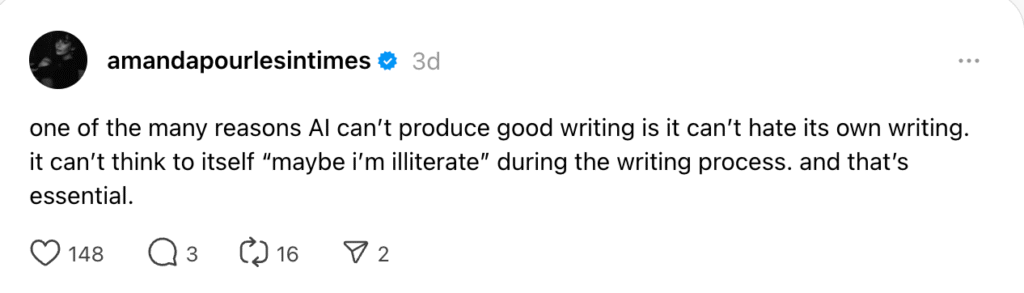
But it brings up a bigger conversation about writing, especially quality control.
→ How do you decide which sentences to keep and which to rewrite?
→ Does your writing spark emotion or sound like a textbook?
→ Is that sentence soft enough to make someone feel heard rather than judged?
→ Does this just “sound good” or will it actually convert the right audience?
A talented writer spends their entire career asking and answering these questions, one sentence at a time.
With that in mind, here’s something you should know about the writing profession:
Everyone will always believe they can do your job.
Your boss, your marketing director, your assistant, and the neighbor who heard you were writing a novel will all tell you they’d write if they had more “free time.”
People think the barrier to entry in professional writing is low because they learn how to diagram a sentence in 5th grade. To the average person, good writing is a paragraph with proper grammar and structure. We all learned how to write essays in high school, and we are natural English experts, right?
It’s interesting to me that no one thinks the same about math. I learned long division in 5th grade, too, but I’m not out here claiming I could be a rocket scientist if I just “had more free time.” I fully understand that high-level engineering takes skills and talent that I can’t gain as a cute little hobby.
It’s the same with writing. Good writing is so much more than a well-formulated paragraph; it’s the act of pulling emotion out of your reader. When I’m writing a book, my goal is for readers to feel more seen and understood by my characters than they do by their best friend. When I’m writing copy, I’m looking for tone, positioning, hooks, storytelling, and relatability all within my client’s unique brand. I’m looking for their ideal client to say, “This brand knows me better than I know myself.”
When you experience good writing in real life, you don’t think to yourself, “Wow, that was beautifully said.” You don’t think about the writing at all. Instead, you experience it. You feel new things, think new thoughts, ask new questions, and have conversations about the text. You say, “I thought I was the only person who felt like this,” and you sit in the goodness of being seen.
From the poorest child to the richest one, from war-ravaged countries to peaceful ones, and from the youngest reader to the oldest, good writing captures what unites us all: the simple experience of being human. And we simply can’t hand that over to robots.
The art of bringing emotion, persuasion, and human connection through writing isn’t a skill people are born with. It’s one you have to learn and earn.
I’ve noticed that people who are so obsessed with AI as a writing tool don’t actually know how to tell the difference between good and bad writing. They’re high on the idea of control and finally getting the time they need to “become a writer.” Yet they don’t recognize the need for quality oversight. Maybe AI sentences sound okay, but the emotional connection and expertise are lost. That’s not just a massive loss for businesses and marketing, it’s a massive loss for our humanity.
Pretty writing gives people an ego.
Picture me: freshly twenty-one, sitting in the literary agent hotseat across from hopeful writers who pitched me their novel ideas. I’ve spent my entire career in writing, from signing a book contract in high school to owning my own copywriting agency in my late 20s. And one of the first things you notice in this field is the ever-present ego.
Ask any writer — we all know about it. The desire for ego boosts at writing conferences is palpable, and it doesn’t usually come from other writers. It comes from people who want to be writers.
Writing a book is a huge accomplishment. For many people, it’s a bucket list item. Anyone who completes that huge a task deserves praise for it — and a lot of times, they get praise. But the thing you’ll notice with genuine writers is that they’ll do it without the praise. The reward for writing a book is the actual experience of writing it.
One of the trends I’ve noticed with AI is that now people who pursue writing for the spotlight, not the craft, are more capable of publishing artificial work. The barrier to entry is seemingly even smaller when you can get a chatbot to write a novel or create art for you, and you still get the credit. That means more noise, more ego, and less quality control.
We need to be aware of how dangerous this is. The barrier to entry with professional writing is a good thing. It keeps people with poor intentions from infiltrating a space that is meant to be sacred and intentional. Writers are not simply writers — we are historians, unbiased reporters, poets, catalysts for social change, and guardians of the human narrative. We desperately need quality control and the barrier to entry to stay intact. It’s our job not just to create beautiful art, but to protect this barrier.
Original thoughts only happen on the blank page.
I recently saw a post that said, “I only use AI to get over my fear of the blank page.”
… Which is maybe the most insane thing I’ve ever heard someone say.
We can all agree the blank page is scary. But that’s a good thing. Every time you create something from nothing, it gets a little easier. The act of overcoming the blank page and creating something from it — despite everything in your body rebelling against it — is what earns you talent, original thought, and a love for the craft. It’s what actually makes you good at writing.
When you skip that critical step, you skip the character building and skill building all together. Plus, AI is only pulling from a bank of pre-created ideas. So even though you think you’re creating something totally new, you’re not.
Writers are most often deep thinkers who have beautiful things to share with the world. Their only barrier is their fear of judgment.
What if I’m not good enough?
What if no one likes what I have to say?
What if my creativity doesn’t stand out?
Sure, AI can take away some fear by filling up the blank page for you. But it also takes away the character growth and original thought that you would otherwise cultivate.
Is the conversation actually about AI, or is it about the pressure on brands to show up in every marketing space?
On the marketing side of things, one of the biggest reasons brands lean into AI for writing is the unrelenting pressure to produce content. There’s the social media accounts, the SEO blog, email list, ads, opt-ins, and video scripts. I get it.
While I completely understand the overwhelm, the solution to this problem isn’t to check off content boxes with robotic-sounding captions. The quality of writing that AI produces is so low that you’ll have customers wondering, “Did the brand actually write this?” This destroys brand credibility, which is hard to rebuild, and you can’t afford that in a low-trust economy.
Here’s what I need brands to understand: Bad content doesn’t perform.
Mediocre content doesn’t perform, either.
Today’s algorithm requires grand slam content creation. You’re aiming for Hollywood-worthy video shots, storytelling scripts, and education that quite literally stops people in their tracks. Unless you have a whole marketing team, it’s unrealistic to make this level of content across all the marketing platforms that exist. It’s much more doable to become an expert in just one or two online spaces.
Sales is all about understanding exactly where your ideal client hangs out, and what they need to hear. It’s about addressing pain points, understanding what makes your brand different, and centering everything around the outcome of your product. Find an online platform that energizes you and lets you show up this way as your most authentic self — and you’ll find content creation to come more naturally without the constant output.
If your connection with people on social media is so impersonal that you need AI to do the writing for you, why are you even on social media?
People love social media as a marketing platform because it’s about connection. You get to know a brand or an entrepreneur on a really personal level, by seeing their face, hearing them talk, and reading their intimate thoughts. When you use AI as the primary way to write your posts, you break that personal connection. As a business owner, that should feel like an immediate loss to you — to not interact directly with your community. If it doesn’t feel like a loss to you, then it will feel like a loss of connection and authenticity with your community.
If you think writing is just about pretty words, you’re missing the point.
A friend of mine was talking to her community about hiring me to write her website. And the resounding answer from her business community was: “Why would you hire a copywriter when you can just use generative AI?”
This question immediately makes me think they missed the entire point of copywriting — because copywriting and writing in general have little to do with pretty words. Words are just the avenue we use to build connection and increase conversions. But it’s not really about the words at all, it’s about the strategy and psychology behind them that AI can’t replicate. It’s the difference between “this websites sounds fine” and “this website makes me want to take action.”
AI removes dignity from artists and creatives.
There has always been some disdain for artists in our modern world (consider the term, “starving artist”). But as a society, removing dignity from artists is one of the most detrimental things we can do. This same thing happened during the industrial age, when craftsmanship was taken from families and artists, who carefully trained the next in their lineage, and passed down tools of the trade. Back then, giving up physical tools meant giving up freedom over our working hours and our energy output. Suddenly, handcraftsmanship was demonized for convenient factory goods, and power was irreversibly given to business owners, not workers. Wealthy men could and did take advantage of families, workers, and children, with most people working 18-hours days before we fought for labor laws.
The subtle comments that I hear in the workplace all the time are things like, “I could write just like you if I had more time,” and “I’m a good writer, I just never pursued because there are better things to do” and “why would you hire a copywriter when you can use AI?” are suddenly undermining writers who have dedicated their lives to this creative work. But not just that… This devaluing of human craftsmanship is taking our tools right out from under us, a repeat of the industrial age.
Letters to explore
Little comforts for your busy life